Tuesday, 9 February 2016

MyMedOpinion Affiliate Paediatric Heart Surgery Hospitals in India

Paediatric Heart Surgery in India with the Best Paediatric Heart surgeons in India is what you would want if your little one is suffering from any heart ailment. MyMedOpinion affiliate Paediatric heart surgeons in India are among the top paediatric heart specialists and offer best in paediatric heart care. Affordable Pediatric Heart Surgery in India at Best Cardiac Hospitals with Top Pediatric Cardiac Surgeons in India with MyMedOpinion.

Sometimes heart surgery in children is required for repairing defects in the heart which a child might have born with (known as congenital heart defects) and heart diseases which he gets after birth, which require surgery. Pediatric Cardiac Surgery deals with operative procedures in the newborn and unborn children and youngsters suffering from cardiac dysfunctions, structural, functional and rhythm-related issues of the heart also.

In the normal heart, electrical impulses arise from an area of specialized cells called the sinus node, which is the heart's normal pacemaker. The sinus node is located in the right atrium, the upper right chamber of the heart . After leaving the sinus node, an impulse spreads across the upper heart chambers (right and left atria) and reaches the atrioventricular (AV) node located near the center of the heart between the atria and the lower chambers, or ventricles, and then to conduction fibers that spread across the ventricles, which are the heart's main pumping chambers. 

As the impulse moves along the conduction fibers, cardiac muscle cells are stimulated and contract, producing a heartbeat.Pediatric Cardiac Surgery often deals with heart problems in children, the cause of congenital heart diseases which are common heart ailments among new born children and involves deficiencies like structural defects, congenital arrythmias and cardiomyopathies, which result in different kinds of abnormalities related to the heart. Congenital heart disease is a cause of improper growth of the heart or blood vessels before birth.


Heart Treatment in India for Major Heart Ailments in Children
The most common cardiac defects in children are the following:

• Atrial Septal Defect
• Ventricular Septal Defect
• Fallot's Tetralogy
• Valvular defects

Atrial Septal Defect
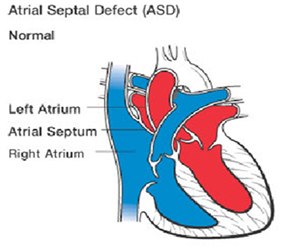
An atrial septal defect (ASD) — sometimes referred to as a hole in the heart — is a type of congenital heart defect in which there is an abnormal opening in the dividing wall between the upper filling chambers of the heart (the atria). In most cases ASDs are diagnosed and treated successfully with few or no complications. When an atrial septal defect is present, blood flows through the hole primarily from the left atrium to the right atrium.
This shunting increases the blood volume in the right atrium which means more blood flows through the lungs than would normally. If left untreated, atrial septal defect may cause problems in adulthood. These problems may include pulmonary hypertension (which is high blood pressure in the lungs), congestive heart failure(weakening of the heart muscle), atrial arrhythmias (which are abnormal rhythms or beating of the heart) and an increased risk of stroke.

Ventricular Septal Defect - VSD have a hole in the wall of their heart between their right ventricle and left ventricle (the two lower chambers, where the blood leaves the heart). Normally, blood cannot pass between the ventricles. But when there is a hole between the sides of the heart, some oxygen-rich blood leaks from the left ventricle into the right ventricle and goes back to the lungs. The hole may be small and cause no symptoms, or it may be large and cause serious problems with blood flow. If the hole is large, too much blood will be pumped to the lungs, leading to congestive heart failure. Also, the heart will have to work harder to pump blood to the body. As a result of the extra work, the heart can get bigger.

There are two main techniques to correct the disorder:
Intra-Cardiac Technique - is an open heart surgery under general anesthesia , whereby the child is attached to an external heart-lung machine. This heart lung machine performs circulatory and respiratory function during surgery. The heart is directly accessed and the defect is sutured.

Trans- Catheter Technique - this is a minimally invasive technique through which surgical instruments are passed through the catheter inserted in the femoral artery. The catheter is slowly guided up towards the point of defect to close it.
Both the procedures are quite successful. Which one is best for your child can be ascertained by the paediatric cardiac surgeon in India after the examination of the child.

Fallot's Tetralogy
Fallot was a doctor who spotted this particular type of heart defect. Tetralogy means fourfold – there are four defects found together. These four problems are: 1. Pulmonary stenosis - Pulmonary means ‘of the lungs’. Stenosis means narrowing. Pulmonary stenosis is a narrowing at or below the pulmonary valve. 2. Ventricular septal defect -Ventricular means ‘of the ventricles’ – the wall between the right and left sides of the heart . 3. Over-riding aorta -The entrance to the aorta, which should only take red (oxygenated) blood around the body, lies over the VSD, allowing the right ventricle to pump some blue blood directly into it. 4. Right ventricular hypertrophy -The right ventricle becomes thickened as it forces blood into the narrowed pulmonary artery.

The heart surgeons perform two surgeries to correct Fallot of Tetralogy heart defect in the child Blalock- Taussig's operation is a palliative procedure performed in smaller infants to increase blood flow to lungs and to allow the child to grow big enough to withstand the corrective surgery. A connection is made between right subclavian artery and pulmonary artery to pass more oxygenated blood to the latter. This relieves the cyanosis to a great extent.

The total corrective surgery is performed in children within 2 years of age. VSD is closed with a patch and the narrowed pulmonary valve is opened. The outcome of surgery is favourable and most children lead a healthy life after the surgery with minimum restrictions

Double valve repair and replacement
Valves are openings between two chambers and also between a chamber and artery which allows unidirectional flow of blood. The patency of these valves is very important for normal flow of blood. The function of mitral valve (between left atrium and left ventricle) and the aortic valve (between left ventricle and aorta) is very important. If these valves get narrowed, the amount of blood passing from left atrium to left ventricle (mitral valve) or from left ventricle to aorta (aortic valve) is drastically reduced. In this case the heart will pump blood harder to push it through the narrowed valves. But the blood will tend to go upwards back into the pulmonary vein and finally to the lungs. 

This will cause excess blood in the lungs leading to congestion. At the same time very less blood will come out into the aorta from the left ventricle which will result in reduced blood and oxygen supply to all the body parts.

Double valve repair and replacement procedure aims at correcting or replacing these both these damaged valves (aortic & mitral together) with new functional valves. This is done through the open heart surgery. The patient is put under general anaesthesia and connected to the heart lung machine. This machine takes over the pumping, circulatory, and respiratory functions of the heart and lung till the surgical procedure is going on. The valves are accessed by cutting open the rib cage and accessing the heart directly. The old valves are sliced from their attachments and new valves are put in their place. 

The new valves may be obtained from a cadaveric donor, or an animal (pig) or it may be made of a nonreactive inert material. The patient needs to be given anticoagulants or immunosuppressive to clotting of blood or rejection of organ. The prognosis of this surgery is good. It is many a time a life-saving and life extending surgery.


Radio frequency catheter ablation is a procedure that is performed to correct a disturbance in heart rhythm (cardiac arrhythmia or irregular heartbeat).
It`s most often used to treat supraventricular tachyarrhythmias which are rapid, uncoordinated heartbeats starting in the heart`s upper chambers (atria) or middle region (AV node or the very beginning portion of the heart`s electrical system). In cardiology, RF ablation is used to correct:
• recurrent atrial flutter.
• atrial fibrillation (AF).
• supraventricular tachycardia (SVT).
• some types of ventricular arrhythmia.


About MyMedOpinion.com

MyMedOpinion affiliated  Best hospitals in India provide an medical opinion from experienced surgeons and the treatment cost includes companion stay  , surgeon fee, medicines and consumables, nursing care, patient's food and airport pick up & drop etc. etc. We offer free, no obligation assistance to international patients to find world class medical treatment in India. We offer support and services to facilitate the care you require. We can help you find the best hospital in India

Send us a Medical Report to Get FREE Medical Opinion from India's Top Doctors

MyMedOpinion.com  is the hub of Surgeons and specialists for major diseases. We give you a chance to speak to our doctors and discuss your health issues directly. 

Monday, 18 January 2016

Atrial Septal Defect (ASD) Surgery in India

What is Atrial Septal Defect (ASD)

An atrial septal defect (ASD) is a hole in the wall between the two upper chambers of your heart. The condition is present from birth (congenital). Smaller atrial septal defects may close on their own during infancy or early childhood. 

Large and long-standing atrial septal defects can damage your heart and lungs. An adult who has had an undetected atrial septal defect for decades may have a shortened life span from heart failure or high blood pressure in the lungs. Surgery is usually necessary to repair atrial septal defects to prevent complications. 

Atrial Septal Asd Surgery, Atrial Septal Asd India


 Atrial Septal Asd India, Atrial Septal Defect Surgery, Atrial Septal Defect


Symptoms of Atrial Septal Defect (ASD)

Many babies born with atrial septal defects don't have signs or symptoms. In adults, signs or symptoms may not develop until age 30 or later. 

Your doctor may first uncover an atrial septal defect during a regular checkup while listening to your heart using a stethoscope. Hearing a heart murmur may signal a hole in your heart. Atrial septal defects are often found when an ultrasound exam of the heart (echocardiogram) is done for another reason. 

Signs and symptoms of atrial septal defects develop once damage occurs to the heart and lungs. Infants with larger atrial septal defects may have poor appetites and not grow as they should. Adults and infants may have signs of heart failure or arrhythmias. 

Signs and symptoms of large or long-standing atrial septal defects may include : -


  • Shortness of breath
  • Fatigue
  • Swelling of legs, feet or abdomen
  • Heart palpitations or skipped beats

^ Back to Top

Causes of Atrial Septal Defect (ASD)

Doctors know that heart defects present at birth (congenital) arise from errors early in the heart's development, but there's often no clear cause. Genetics and environmental factors may play a role. 

An atrial septal defect allows freshly oxygenated blood to flow from the left upper chamber of the heart (left atrium) into the right upper chamber of the heart (right atrium). There it mixes with deoxygenated blood and is pumped to the lungs, even though it's already refreshed with oxygen. If the atrial septal defect is large, this extra blood volume can overfill the lungs and overwork the heart. If not treated, the right side of the heart eventually enlarges and weakens. In some cases, the blood pressure in your lungs increases as well, leading to pulmonary hypertension. 


Comparing ASD with patent foramen ovale 

The term "atrial septal defect" usually refers to holes in the atria resulting from a lack of atrial septal tissue, rather than those related to a condition called patent foramen ovale (PFO). 

Patent foramen ovale occurs when part of the normal fetal heart circulation fails to close properly at birth. During fetal heart development, a channel (the foramen ovale) is present between the atria to allow blood to bypass the lungs. At birth, once the lungs take over breathing, the hole normally closes. In about one in three people, this opening doesn't close. 


Treatments and drugs for Atrial Septal Defect (ASD) in India

If your child has an atrial septal defect, your doctor may recommend monitoring it for a period of time to see if it closes on its own, while treating any symptoms with medications. 

According to the National Institutes of Health, about half of all atrial septal defects eventually close on their own. About 20 percent close within the first year of life. If a hole hasn't closed early in childhood, it usually won't close on its own. Some small atrial septal defects don't cause any problems and may not need closure, but many require surgery to be corrected. If your child needs treatment, the timing of it depends on your child's condition and whether your child has any other congenital heart defects. 


Surgery of Atrial Septal Defect (ASD) in India

Many doctors recommend repairing an atrial septal defect diagnosed during childhood to prevent complications as an adult. For adults and children, surgery involves plugging or patching the abnormal opening between the atria. 

Doctors can do this through two methods : -


  • Cardiac catheterization : - ASD Closure. A thin tube (catheter) is inserted into a blood vessel in the groin and guided to the heart. Through the catheter, a mesh patch or plug is put into place to close the hole. The heart tissue grows around the mesh, permanently sealing the hole.

  • Open-heart surgery : - This type of surgery is done under general anesthesia and requires the use of a heart-lung machine. Through an incision in the chest, surgeons use patches or stitches to close the hole.

Follow-up care depends on the type of defect and whether other defects are present. For simple atrial septal defects closed during childhood, only occasional follow-up care is needed. For adults, follow-up care may depend on any resulting complications. 

Tuesday, 24 November 2015

Affordable Pediatric Cardiac Surgery at Best Hospital in India

Paediatric Heart Surgery in India with the Best Paediatric Heart surgeons in India is what you would want if your little one is suffering from any heart ailment. MyMedOpinion affiliate Paediatric heart surgeons in India are among the top paediatric heart specialists and offer best in paediatric heart care. Affordable Pediatric Heart Surgery in India at Best Cardiac Hospitals with Top Pediatric Cardiac Surgeons in India with MyMedOpinion.

Sometimes heart surgery in children is required for repairing defects in the heart which a child might have born with (known as congenital heart defects) and heart diseases which he gets after birth, which require surgery. Pediatric Cardiac Surgery deals with operative procedures in the newborn and unborn children and youngsters suffering from cardiac dysfunctions, structural, functional and rhythm-related issues of the heart also.
Pediatric Cardiac Surgery often deals with heart problems in children, the cause of congenital heart diseases which are common heart ailments among new born children and involves deficiencies like structural defects, congenital arrythmias and cardiomyopathies, which result in different kinds of abnormalities related to the heart. Congenital heart disease is a cause of improper growth of the heart or blood vessels before birth.

Heart Treatment in India for Major Heart Ailments in Children

The most common cardiac defects in children are the following:
  •    Atrial Septal Defect
  •    Ventricular Septal Defect
  •    Fallot's Tetralogy
  •    Valvular defects
Atrial Septal Defect
An atrial septal defect (ASD) — sometimes referred to as a hole in the heart — is a type of congenital heart defect in which there is an abnormal opening in the dividing wall between the upper filling chambers of the heart (the atria). In most cases ASDs are diagnosed and treated successfully with few or no complications. When an atrial septal defect is present, blood flows through the hole primarily from the left atrium to the right atrium.
This shunting increases the blood volume in the right atrium which means more blood flows through the lungs than would normally. If left untreated, atrial septal defect may cause problems in adulthood. These problems may include pulmonary hypertension (which is high blood pressure in the lungs), congestive heart failure(weakening of the heart muscle), atrial arrhythmias (which are abnormal rhythms or beating of the heart) and an increased risk of stroke.

Ventricular Septal Defect - VSD have a hole in the wall of their heart between their right ventricle and left ventricle (the two lower chambers, where the blood leaves the heart). Normally, blood cannot pass between the ventricles. But when there is a hole between the sides of the heart, some oxygen-rich blood leaks from the left ventricle into the right ventricle and goes back to the lungs. The hole may be small and cause no symptoms, or it may be large and cause serious problems with blood flow. If the hole is large, too much blood will be pumped to the lungs, leading to congestive heart failure. Also, the heart will have to work harder to pump blood to the body. As a result of the extra work, the heart can get bigger.

There are two main techniques to correct the disorder:

Intra-Cardiac Technique - is an open heart surgery under general anesthesia , whereby the child is attached to an external heart-lung machine. This heart lung machine performs circulatory and respiratory function during surgery. The heart is directly accessed and the defect is sutured.
Trans- Catheter Technique - this is a minimally invasive technique through which surgical instruments are passed through the catheter inserted in the femoral artery. The catheter is slowly guided up towards the point of defect to close it.
Both the procedures are quite successful. Which one is best for your child can be ascertained by the paediatric cardiac surgeon in India after the examination of the child.

Fallot's Tetralogy
Fallot was a doctor who spotted this particular type of heart defect. Tetralogy means fourfold – there are four defects found together. These four problems are: 1. Pulmonary stenosis - Pulmonary means ‘of the lungs’. Stenosis means narrowing. Pulmonary stenosis is a narrowing at or below the pulmonary valve. 2. Ventricular septal defect -Ventricular means ‘of the ventricles’ – the wall between the right and left sides of the heart . 3. Over-riding aorta -The entrance to the aorta, which should only take red (oxygenated) blood around the body, lies over the VSD, allowing the right ventricle to pump some blue blood directly into it. 4. Right ventricular hypertrophy -The right ventricle becomes thickened as it forces blood into the narrowed pulmonary artery.

The heart surgeons perform two surgeries to correct Fallot of Tetralogy heart defect in the child
Blalock- Taussig's operation is a palliative procedure performed in smaller infants to increase blood flow to lungs and to allow the child to grow big enough to withstand the corrective surgery. A connection is made between right subclavian artery and pulmonary artery to pass more oxygenated blood to the latter. This relieves the cyanosis to a great extent.
The total corrective surgery is performed in children within 2 years of age. VSD is closed with a patch and the narrowed pulmonary valve is opened. The outcome of surgery is favourable and most children lead a healthy life after the surgery with minimum restrictions

Double valve repair and replacement
Valves are openings between two chambers and also between a chamber and artery which allows unidirectional flow of blood. The patency of these valves is very important for normal flow of blood. The function of mitral valve (between left atrium and left ventricle) and the aortic valve (between left ventricle and aorta) is very important. If these valves get narrowed, the amount of blood passing from left atrium to left ventricle (mitral valve) or from left ventricle to aorta (aortic valve) is drastically reduced. In this case the heart will pump blood harder to push it through the narrowed valves. But the blood will tend to go upwards back into the pulmonary vein and finally to the lungs. This will cause excess blood in the lungs leading to congestion. At the same time very less blood will come out into the aorta from the left ventricle which will result in reduced blood and oxygen supply to all the body parts.

Double valve repair and replacement procedure aims at correcting or replacing these both these damaged valves (aortic & mitral together) with new functional valves. This is done through the open heart surgery. The patient is put under general anaesthesia and connected to the heart lung machine. This machine takes over the pumping, circulatory, and respiratory functions of the heart and lung till the surgical procedure is going on. The valves are accessed by cutting open the rib cage and accessing the heart directly. The old valves are sliced from their attachments and new valves are put in their place. The new valves may be obtained from a cadaveric donor, or an animal (pig) or it may be made of a nonreactive inert material. The patient needs to be given anticoagulants or immunosuppressive to clotting of blood or rejection of organ. The prognosis of this surgery is good. It is many a time a life-saving and life extending surgery.

Why is the Procedure required?
If the following warning signs are found in children, it indicates that a surgery is required:
·         Blue or gray skin, nail beds and lips. These symptoms indicate that there is not enough oxygen in the blood (hypoxia).
·         If the child has difficulty in breathing because the lungs are "wet," congested, or filled with fluid (heart failure).
·         If there exists problems in heart rhythm (arrhythmias) or heart rate.
·         If there is lack of growth and development of a child. And the child is not able to sleep and eat properly.

FAQ's  Pediatric Cardiac Surgery  in India

What is the cost of Paediatric Heart Surgery?
Paediatric Heart Surgery is amongst the lowest in the world. The Paediatric Heart Surgery is about 20% of the cost in the USA. The low Paediatric Heart Surgery is without any compromise on quality or success rate

Are cardiac surgeons in India well qualified to perform heart surgeries?
Teaching hospitals in India are of a high standard. Further, many cardiac surgeons and cardiologists from India have had further education/training abroad at top class medical schools and hospitals. The result is a very high level of academic excellence amongst cardiologists and cardiac surgeons in India.

How experienced are cardiac surgeons in India at handling complex heart surgeries?
The translation of academic excellence into outstanding medical results happens only with practice and experience. Indian doctors acquire a great amount of experience over a very short period of time because of the large number of patients requiring cardiac treatment in India.

Do surgeons perform advanced heart surgeries in India?
Cardiac surgeons in India are experts at performing advanced procedures like Heart Transplants, Robotic Cardiac Procedures, Totally Endoscopic Coronary Artery Bypass Surgery (TECAB), Minimally Invasive Direct Coronary Artery Bypass Grafting (MIDCAB), Off-Pump Coronary Artery Bypass Grafting (OPCAB), complex mitral valve repairs, etc.

What success rates can one expect in India from cardiology hospitals?
It is quite amazing that Indian hospitals are able to offer a combination of extremely low cost cardiac treatment in India along with extremely high success rates as well. In fact, leading hospitals for cardiac treatment in India have success rates in excess of 98%, which is absolutely world-class.

Get a free of cost second opinion from renowned surgeons within 24 hours

For further information or free consultation, we request you to fill in inquiry form on the website and send medical reports to info@mymedopinion.com. MyMedOpinion assures you that all arrangements for examinations, surgeries, and post-operative recuperation will be ably taken care of you

Get the MyMedOpinion Advantage
MyMedOpinion help by its expertise and speed and quality of response. From arranging opinion from India's best cancer hospitals, hospital appointment bookings, travel and hotel accommodation, we manage our patient’s needs efficiently.

·         Quick responses… Within 24-hours
·         World class results for  treatment
·         Cancer specialists with great qualifications and experience

·         Assistance to Plan your Travel and Apply for India visa.

Wednesday, 28 October 2015

Most Advanced Fallot's Tetralogy Surgey in India | Best Child Heart Surgery Hospital India

Fallot's Tetralogy Surgey

Tetralogy of Fallot is the most common heart defect in children. The condition causes mixing of oxygen-poor blood with the oxygen-rich blood being pumped out of the heart and into the circulatory system of blood vessels.

·         The blood leaving the heart has less oxygen than is needed by the organs and tissues of the body, a condition called hypoxemia.
·         Chronic (ongoing, long-term) lack of oxygen causes cyanosis, a bluish color of the skin, lips, and membranes inside the mouth and nose.
The normal heart works as follows:
·         The heart is made up of 4 chambers: 2 upper chambers called atria and 2 lower, larger chambers called ventricles. Each atrium is separated from its paired ventricle by a valve.
·         The heart has a left and a right side. The left and right sides of the heart are separated by a septum (wall). The right side of the heart receives oxygen-depleted or blue blood returning by veins (superior vena cava and inferior vena cava) from the body.
·         The blood flows from the right atrium through the tricuspid valve into the right ventricle, which pumps it through the pulmonic valve into the pulmonary artery, the main artery to the lungs.
·         In the lungs, the blood absorbs oxygen and then returns to the left atrium through the pulmonary veins.
·         From the left atrium, the blood is pumped through the mitral valve to the left ventricle. The left ventricle pumps the blood out of the heart into the circulatory system via a large artery known as the aorta.
·         The blood moves throughout the body, supplying oxygen and nutrients to organs and cells.
·         Organs cannot work properly if they do not receive enough oxygen-rich blood.
The 4 abnormalities (tetralogy) of the heart described by Fallot include the following:
·         Right ventricular hypertrophy: Narrowing or blockage of the pulmonary valve and/or muscle under the pulmonary valve coming out of the right ventricle. This restriction to blood outflow causes an increase in right ventricular work and pressure, leading to right ventricular thickening or hypertrophy.
·         Ventricular septal defect (VSD): This is a hole in the heart wall (septum) that separates the 2 ventricles. The hole is usually large and allows oxygen-poor blood in the right ventricle to pass through, mixing with oxygen-rich blood in the left ventricle. This poorly oxygenated blood is then pumped out of the left ventricle to the rest of the body. The body gets some oxygen, but not all that it needs. This lack of oxygen in the blood causes cyanosis.

·         Abnormal position of the aorta: The aorta, the main artery carrying blood out of the heart and into the circulatory system, exits the heart from a position overriding the right and left ventricles. (In the normal heart, the aorta exits from the left ventricle.) This is not of major importance in infants.
·         Pulmonary valve stenosis (PS): The major issue with tetralogy of Fallot is the degree of pulmonary valve stenosis, since VSD is always present. If the stenosis is mild, minimal cyanosis occurs, since blood still mostly travels to the lungs. However, if the PS is moderate to severe, a smaller amount of blood reaches the lungs, since most is shunted right-to-left through the VSD.
Tetralogy of Fallot Symptoms
Most infants with tetralogy of Fallot develop cyanosis in the first year of life.
·         The skin, lips, and mucous membranes inside the mouth and nose take on a noticeably dusky blue color.
·         Only some infants with very severe obstruction of the right ventricle outflow turn blue at birth.
·         A small number of children with tetralogy of Fallot never turn blue at all, especially if the pulmonary stenosis is mild, the ventricular septal defect is small, or both.
·         In some children, the cyanosis is quite subtle and may go undetected for some time.
The following symptoms suggest tetralogy of Fallot:
·         Growth and development are slower, especially if the pulmonary stenosis is severe. Puberty may be delayed if the tetralogy is untreated.
·         The child usually tires easily and begins panting with any form of exertion. He or she may play for only a short time before sitting or lying down.
·         Once able to walk, the child often assumes a squatting position to catch his or her breath and then resumes physical activity. Squatting increases the pressure transiently in the aorta and left ventricle, causing less blood to move into the left ventricle, more out the pulmonary artery to the lungs.

Surgery is the primary way to correct the heart problem. Your child may be prescribed medication for tet spells. You will also be given information for dealing with future tet spells.
·         The child will be placed on his or her back in the knee-to-chest position to increase aortic resistance. The increased aortic and left ventricular pressure reduces the rush of blood through the septal hole from the right ventricle and improves blood circulation to the lungs, so more red blood reaches the tissues.

·         The child may be given oxygen through a face mask to increase the amount of oxygen in the blood.